

What We Offer
Foundry Enablement
Epiphany empowers foundries by optimizing processes and expanding the possibilities within the design and development landscape.

PDK Development
We support photonic foundries with improved PDK (Process Design Kit) services and connect them to a broader range of users. Our xPDK services support multiple EDA software tools — including Synopsys, Luceda, PhotonDesign, VPI Photonics, and Klayout— streamlining PDK handling.

Building Block Design
We provide expertise in handling and automating the design flow, enabling the creation of custom-building blocks and IP blocks. This not only introduces new functionalities but also ensures operational flexibility.

Test & Characterization
Epiphany assists in defining and executing the right tests to validate platform performance, ensuring reliability and consistency across the fabrication process.

Brokerage
We could act as intermediary between foundries and their customers, ensuring mask designs are verified, addressing technical inquiries, and handling all necessary interactions, allowing the fab to focus on manufacturing process.
More About PIC Materials
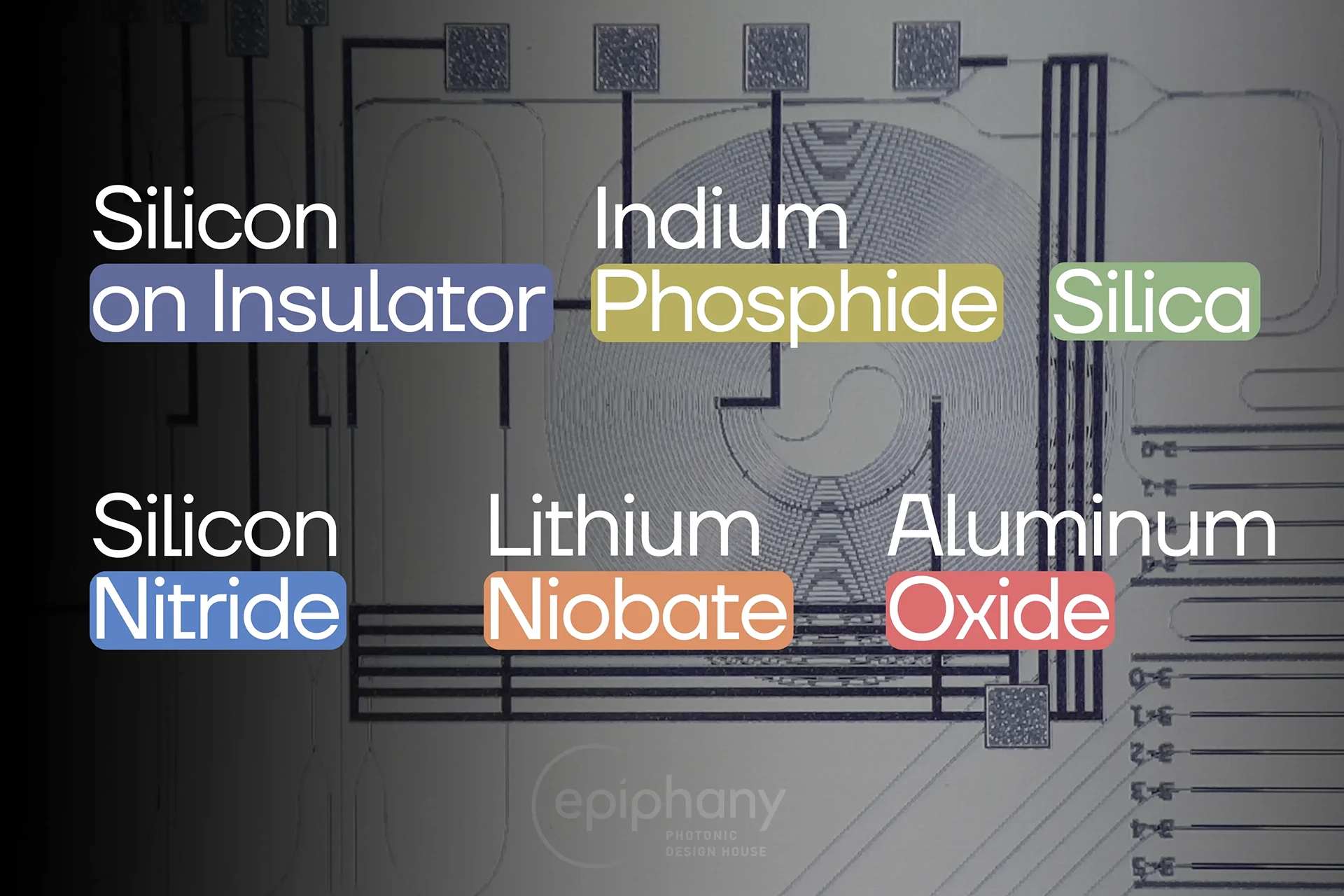
A Guide to PIC Technologies
Explore the strengths and use cases of different photonic integrated circuit (PIC) technologies—and find out which one fits your application best.

Foundry Enablement Services BROCHURE
We created a brochure offering more details about our Foundry Enablement Services. Download the PDF to learn more.
Download the Foundry Enablement BrochureThe Answers to your Questions
Frequently Asked Questions
What is photonic foundry enablement?

Photonic foundry enablement refers to the process of preparing a photonic fabrication platform so that external designers can reliably design and fabricate Photonic Integrated Circuits (PICs).
This typically involves developing Process Design Kits (PDKs), defining design rules, organizing documentation, and establishing design flows compatible with industry-standard Electronic (Photonic) Design Automation (EPDA) tools.
Epiphany supports photonic foundries in building these capabilities, helping transform internal fabrication processes into accessible and reliable design platforms.
Who is the Foundry Enablement service intended for?
Foundry enablement services are intended for organizations operating or developing photonic fabrication processes.
Typical users include photonic foundries, research fabrication facilities transitioning toward production, universities operating fabrication lines, and organizations aiming to provide open-access fabrication services or multi-project wafer (MPW) programs.
Epiphany supports these organizations in building the infrastructure required for external chip designers to access and use their fabrication processes.
Why do photonic foundries need enablement services?
Many photonic fabrication facilities start in research environments where processes evolve through experimentation. While this environment is ideal for developing new technologies, it often lacks the structure required for external designers to reliably use the process.
To operate as a foundry, fabrication platforms need clear design rules, documentation, validated building blocks, and stable design kits. Foundry enablement services help establish this structure and make the technology accessible to designers such that foundries can focus on developing their processes.
What challenges do research photonics fabs face when becoming a foundry?
Research fabrication facilities often have strong process expertise but limited infrastructure for external design users and implementing a professional design flow.
Typical challenges include incomplete documentation, lack of standardized design rules, missing design kits, or difficulty integrating fabrication data with photonic design tools. As a result, external designers may struggle to design chips that are compatible with the process.
Foundry enablement focuses on bridging this gap between fabrication knowledge and usable design infrastructure.
What services does Epiphany provide for photonic foundries?
Epiphany supports photonic foundries through several enablement services, which include:
- Foundry strategy workshops
- Development and management of Process Design Kits (PDKs)
- Implementation of cross-platform Process Design Kits (xPDKs)
- Conversion of internal process data into software-compatible design kits
- Implementation of infrastructure for ongoing design kit development and maintenance
These services help foundries provide stable and accessible design environments for external chip designers.
What is a photonic Process Design Kit (PDK)?
A photonic Process Design Kit (PDK) is a collection of design information that allows engineers to design photonic integrated circuits compatible with a specific fabrication process.
A PDK typically includes design rules, layout layers, building block libraries, simulation models, and documentation describing how devices behave within the fabrication platform.
PDKs are essential for enabling external designers to develop chips that can be reliably fabricated by a photonic foundry.
How is a photonic PDK developed?
Developing a PDK involves translating internal fabrication knowledge and foundry data into structured design information that can be used by chip designers and used with EPDA tools.
This includes defining layout layers, creating design rules, developing parameterized building blocks, integrating simulation models, and generating documentation and verification flows.
Epiphany supports foundries throughout this process by structuring fabrication data, creating design modules and libraries, and ensuring compatibility with photonic design tools.
What is a cross-platform PDK (xPDK)?
A cross-platform PDK, or xPDK, is a design kit architecture that allows a single PDK definition to be used across multiple photonic design tools.
Instead of maintaining separate PDK implementations for each software environment, the xPDK approach enables foundries to maintain one central design kit that can be converted into different tool formats.
This “write once, use many times” approach reduces maintenance effort and helps ensure consistency across different design environments.
Why is support for multiple design tools important for photonic foundries?
Photonic chip designers use a wide range of electronic and photonic design tools depending on their workflow and organization. If a foundry only supports a single software environment, it may limit the number of designers able to use the process.
By supporting multiple design tools through standardized PDKs or xPDK frameworks, foundries can make their fabrication platforms accessible to a broader design community.
How can a research fabrication facility transition into a photonic foundry?
Transitioning from a research fabrication environment to a foundry requires establishing stable processes and providing external designers with reliable design infrastructure.
This includes defining design rules, creating PDKs, documenting fabrication capabilities, establishing design flows, and implementing systems for maintaining and updating design kits as the process evolves.
Epiphany helps foundries define this transition through technical workshops and structured development of design infrastructure.
How does Epiphany help define a photonic foundry roadmap?
Epiphany offers a Foundry Brainstorm Workshop that helps technical and management teams align on the goals of their fabrication platform.
During these sessions, topics such as target users, documentation level, process control, and long-term development strategy are discussed. The outcome is a structured roadmap that supports the transition from experimental fabrication to stable foundry operations.
What Else We Offer
More Services from Epiphany

Production Support
As an independent design house, Epiphany offers tailored support to help you choose the ideal foundry, packaging & testing partner for your project.

PIC Design
With over 35 years of experience in PIC Design, Epiphany accompanies you from your first idea to the production of your personalized PIC.

Hybrid Laser Design Module
Rather than starting your photonic design from scratch, this solution represents a ready-to-integrate module, enabling you to focus on advancing other aspects of your PIC project.
Contact Us
Our Journey Together
We can accompany you every step of the way, from your first idea to your final PIC. Our advantage of being a fabless design house allows us to tailor each step to your individual needs.


