

Photonic Technology
Aluminium Oxide
Aluminium oxide is a photonic integrated circuit (PIC) platform known for its wide transparency range and high power handling. Read on this page to learn more about aluminium oxide characteristics, applications, and comparison to other PIC platforms.
Learn about Lithium Niobate
Why use this Technology
Overview
Aluminium oxide (AlOx) has unique properties not found in other PIC materials. Notably, it exhibits a high rare earth ion solubility, which makes doped AlOx a good candidate for creating on-chip amplifiers.
Characteristics
AlOx is the amorphous or nanocrystalline form of sapphire. It is deposited by physical vapor deposition methods such as reactive ion sputtering, and the material properties depend on the deposition parameters. It typically has a refractive index around 1.72. Propagation losses may be as low as 0.2 dB/cm in the C-band, and 3 dB/cm around 400 nm wavelengths.
It can be doped with rare earth ions such as Er, Nd, Tb, and Th during the deposition process. The small-signal gain of AlOx waveguide amplifiers can be 16 dB. These amplifiers need to be optically pumped using for example a DFB laser. The nonlinear effects in AlOx are very weak, which minimizes signal distortion relative to III-V diode amplifiers.
Furthermore, AlOx features a wide transparency window ranging from the mid-infrared at 5500 nm all the way down to ultraviolet at 150 nm. Combined with the possibility for monolithic integration with other passive platforms such as Silicon Nitride or Silicon-on-Insulator, AlOx opens the door towards scalable active-passive photonic chips.
Applications
AlOx is a great choice for amplifiers for long-distance telecommunications, as the rare earth dopants allow for high amplification with little signal distortion or noise. This makes AlOx photonic integrated circuits a viable replacement for EDFA systems, enabling scalable and on-chip EDWA systems.
As either the gain material or feedback circuit, it can also be used for narrow linewidth and high power lasers where III-V materials are challenging. For example, 405 nm lasers have been demonstrated using a GaP gain section and AlOx feedback circuit. UV transparency has applications in quantum technologies, for example for ion trapping.
Bring your PIC project to life
At Epiphany Design, we work with all PIC material platforms and always advise our customers on the best choice for their particular applications. When it comes to aluminium oxide photonics, we know how to make the most of its strengths to create solutions across a wide range of use-cases. We specialize in PIC Design, but also provide support at all stages of PIC development when needed.
Learn about Different Photonic Technologies
Explore Photonic Materials

Overview
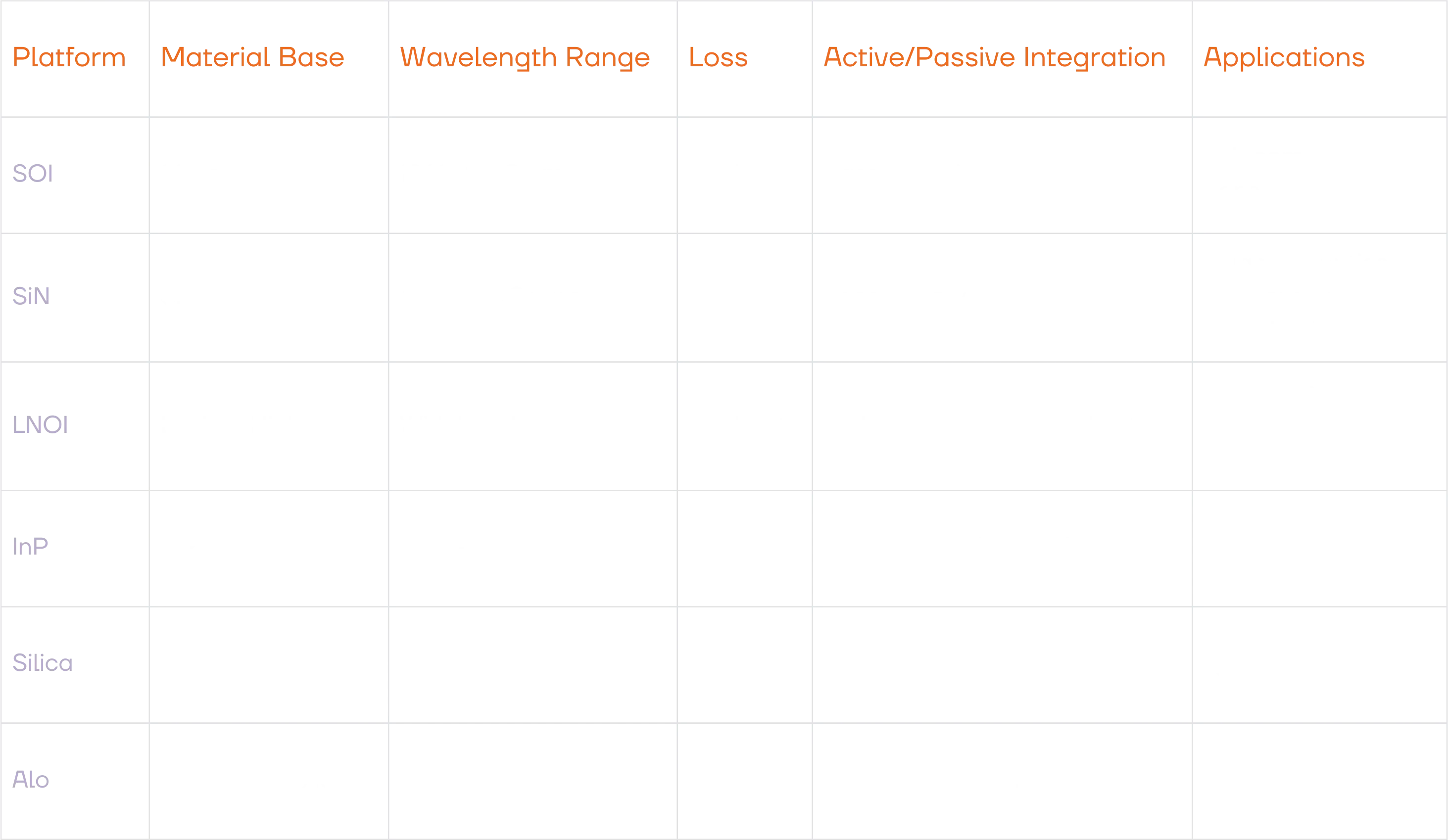
Use the comparison table at the bottom of this page to get an overview of all the materials & and their specifications.

Silicon on Insulator
Silicon On Insulator (SOI), also known as Silicon Photonics (SiP) technology, is the most mature platform for photonic integrated circuits.

Indium Phosphide
Indium phosphide is a photonic integrated circuit material suited for active functionality. Beyond passive light routing, it can generate, amplify and detect light.

Silicon Nitride
Silicon Nitride is a photonic integrated circuit platform known for its low propagation loss and broad transparency.

Lithium Niobate
LNOI is a PIC material valued for high-speed, linear electro-optic modulation and wide transparency from visible to mid-infrared wavelengths.

Silica
Coming up soon! Send us a message if you’d like to receive more information before this part of the guide is published.
Check out the Comparison Table
Compare PIC Technologies
Contact Us
Our Journey Together
We can accompany you every step of the way, from your first idea to your final PIC. Our advantage of being a fabless design house allows us to tailor each step to your individual needs.


